What Does the ECB’s Latest Interest Rate Increase Mean for Property Buyers, Sellers and Renters in Dublin and Naas?
-
by Colene Faulkner
- June 26, 2026
- Property Sales, Real Estate
- 0
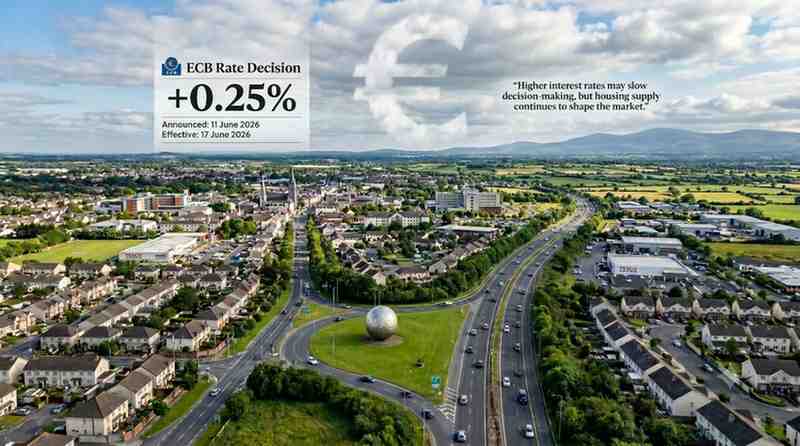
The European Central Bank announced a 0.25% increase in its key interest rates on 11 June, with the change taking effect on 17 June. The move, prompted by renewed inflationary pressures linked largely to rising energy costs, brings the Deposit Facility Rate to 2.25%, the Main Refinancing Operations Rate to 2.40%, and the Marginal Lending Facility Rate to 2.65%.
Interest rate announcements can sometimes appear distant from everyday property decisions, yet they influence many of the conversations taking place across Dublin and Naas today. Buyers reviewing mortgage approvals, sellers considering whether to move, landlords assessing costs, and first-time purchasers trying to understand their options are all watching developments closely.
While borrowing costs have increased, the Irish property market remains shaped by a much larger issue. Supply continues to fall short of demand across much of the country. That imbalance has defined the market for several years and remains the backdrop against which every interest rate decision is judged.
Why Does the ECB Interest Rate Increase Matter for the Irish Property Market?
An ECB interest rate increase affects mortgage affordability, borrowing capacity and market confidence. In Ireland, those effects are often moderated by limited housing supply and sustained demand for homes.
Property markets rarely react to interest rate changes in a straight line. Behaviour tends to shift before prices do. Following major rate announcements, buyers often become more cautious, mortgage brokers see an increase in queries, and sellers pay closer attention to market sentiment. Activity does not stop, but decision-making can become more measured.
In Dublin and Naas, there is little evidence that demand for good-quality homes has disappeared. What changes is the way buyers approach the market. More attention is given to monthly repayments, energy efficiency, future running costs and the amount of work a property may require after purchase.
The result is often a market that continues to function, but with greater scrutiny from everyone involved.
What Does the Rate Increase Mean for People Looking to Sell?
Higher interest rates can reduce purchasing power for some buyers, but limited housing stock continues to support demand for well-located and well-presented homes.
One of the most common assumptions after a rate increase is that house prices will immediately come under pressure. In practice, sellers in Dublin and Naas are operating in a market where available stock remains relatively limited. That continues to create competition for properties that are realistically priced and presented well.
An interesting trend often emerges when borrowing costs rise. Some homeowners who were considering moving decide to delay their plans rather than take on a more expensive mortgage. Fewer properties coming to market can help maintain supply shortages, which in turn supports values.
Buyers are also becoming increasingly selective. During viewings, discussions frequently turn to BER ratings, heating systems, insulation and expected running costs. Homes that require substantial upgrading can face more questions than they might have received a few years ago. Properties that are energy efficient and ready to occupy tend to attract stronger interest because buyers are already factoring higher mortgage repayments into their overall budgets.
For sellers, presentation remains important, but so too does demonstrating value. Buyers are analysing the full cost of ownership more carefully than before.
What Does the Rate Increase Mean for Buyers?
Higher interest rates can reduce borrowing capacity and increase monthly mortgage repayments, making affordability a more significant consideration for many buyers.
For purchasers already progressing through the mortgage process, the immediate concern is often not the quarter-point increase itself but how lenders respond to the broader interest rate environment. Small changes in rates can influence the amount a buyer is approved to borrow and can alter repayment calculations across the lifetime of a mortgage.
Across Dublin, affordability remains one of the dominant challenges. As a result, many buyers continue to widen their search areas. Naas, along with other commuter locations in Kildare, has benefited from this trend for several years. Improved transport links, strong local amenities and relatively better value compared with parts of Dublin continue to attract interest.
There is also a behavioural aspect to rate increases. Buyers often become more deliberate in their decision-making. Surveys, BER reports and property condition assessments receive greater attention. The urgency that can drive highly competitive bidding is sometimes replaced by a more considered approach.
That does not necessarily reduce demand, but it can change the pace of transactions.
What Does the Rate Increase Mean for Renters?
Higher interest rates can increase pressure on the rental market by delaying home purchases and keeping prospective buyers in rental accommodation for longer.
This is one of the less obvious consequences of rising rates. Not every potential buyer leaves the market entirely when borrowing costs increase. Many simply postpone their purchase and remain in rented accommodation while they reassess their options.
For Dublin’s rental market, where supply remains constrained, that can contribute to continued competition for available properties. Similar patterns are increasingly visible in Naas and surrounding commuter towns, where rental demand has remained strong despite wider economic uncertainty.
Tenants searching for accommodation are often competing against a growing number of applicants. In many cases, demand is being driven by people who would prefer to purchase but have chosen to wait until they have greater certainty around mortgage affordability.
The ECB does not directly influence rental prices, but its decisions can have a meaningful impact on rental demand. In a market already characterised by limited supply, that influence should not be underestimated.
What Does the Rate Increase Mean for First-Time Buyers?
First-time buyers face additional affordability challenges when interest rates rise, particularly when combined with deposit requirements and limited housing supply.
Many first-time buyers had been hoping to see a continued downward trend in borrowing costs. The announcement on 11 June introduced a degree of uncertainty into those expectations. While a quarter-point increase is unlikely to transform the market overnight, it does affect budgeting decisions.
Mortgage approval limits remain a central concern. Buyers are paying close attention to how much they can borrow and what repayments will look like over the coming years. Conversations with first-time buyers increasingly revolve around affordability rather than simply finding the right property.
Yet supply remains the overriding challenge. In many parts of Dublin and Naas, the number of suitable homes available to first-time purchasers remains limited. Even if some buyers step back temporarily, competition for well-priced properties continues.
This leaves many first-time buyers balancing two competing concerns: waiting in the hope that borrowing conditions improve, or moving ahead while suitable properties are available.
What Does the Rate Increase Mean for Landlords?
Landlords are facing higher financing costs alongside increasing operational expenses, creating renewed focus on efficiency, compliance and long-term property performance.
The ECB cited inflationary pressures linked to energy costs as a factor behind the latest rate decision. Those same pressures affect landlords in multiple ways. Maintenance costs, contractor rates, service charges, insurance premiums and building management expenses have all experienced upward pressure in recent years.
For landlords with mortgage debt, higher borrowing costs add another layer of consideration. At the same time, demand for rental accommodation remains strong across Dublin and increasingly across commuter locations such as Naas.
Many landlords are also navigating evolving compliance requirements, BER expectations and ongoing maintenance obligations. This has increased the importance of effective property management Dublin services, particularly for investors managing multiple properties or living some distance from their rental assets.
Property management today extends far beyond rent collection. Landlords are placing greater emphasis on maintenance planning, tenant coordination, inspections, compliance monitoring and protecting the long-term value of their properties.
The Housing Supply Challenge Still Defines the Market
Interest rates influence affordability, borrowing behaviour and confidence, but they do not fundamentally alter the shortage of homes available across Ireland.
That remains the central challenge facing the Dublin property market, the Naas property market and the wider housing sector.
A quarter-point increase will affect individual decisions. Some buyers may delay purchases. Some sellers may postpone moving. Some first-time buyers may review their budgets. Landlords may reassess financing and operating costs.
Yet the underlying issue remains unchanged. Demand continues to outpace supply across large parts of the country.
At Howley Souhan, discussions with buyers, sellers, landlords and tenants consistently return to the same themes: affordability, availability and confidence. Interest rates shape those conversations, but housing supply continues to shape the market itself.
For now, the latest ECB decision adds another consideration for property owners and purchasers. It does not change the fact that competition for quality homes remains strong, particularly in Dublin, Naas and many of Ireland’s most sought-after residential locations.